
3G Energy Station
3G Energy Stations are multi-utility energy hubs designed along India’s e-highway corridors, integrating renewable energy, EV charging, essential highway services and intelligent network systems under the Annuity Hybrid E-Mobility (AHEM) PPP model, with development and operations structured on a Design–Build–Operate–Transfer (DBOT) basis.
E-Highway Expansion
E-Highways Nationwide
Station Types — A / B / C
Core Station Components

DESIGN PHILOSOPHY
Modular Design
A 3G Energy Station is designed the same way modern airport terminals are — not as one fixed building, but as a common core that independent, repeatable modules can be attached to over time. Each functional zone of the station, from entry and charging bays to retail, utility and support areas, is engineered as a standardised block that can be assembled, scaled up, or reconfigured without disrupting live operations, exactly like an airport adding a new pier or gate to an existing terminal.
This is what makes the station format inherently expandable: the same modular construction logic lets a station grow from a Type C footprint to Type B or Type A as land, demand and traffic increase, and lets future modules be added years after commissioning — without redesigning or rebuilding the station from scratch. The station is planned once, and grows the way an airport does: terminal by terminal, module by module.
POWER ARCHITECTURE
Energy Spectrum of the Station
Independent of its modular layout, each station is engineered for a total energy demand of 3.2 MWh (3,200 kWh), delivered through four compact 800 kWh substations drawing on a mix of thermal grid, solar, wind and hydrogen sources. This energy mix is designed to shift over time as renewable capacity comes online, without any change to the station's physical footprint.
Evolution of energy dispensing (2027–2040): 2027–30 runs an equal 50% solar / 50% thermal-grid split; 2030–35 introduces wind, balancing solar, wind and thermal; by 2035–40 hydrogen is added and thermal share drops below 25%. By 2040, capacity doubles to 6,400 kWh/hour (5th Generation), fully powered by solar, wind and hydrogen.

Substation 01
800 kWh — Thermal Grid

Substation 02
800 kWh — Solar + Storage

Substation 03
800 kWh — Wind (Roadside)

Substation 04
800 kWh — Green Hydrogen
STATION FRAMEWORK
Four Major Components of the 3G Energy Station
The station is engineered around four functional pillars. Every partner, vendor and service at a 3G Energy Station is mapped under one of these four components.
Green Energy
Power generation, storage and mobility infrastructure — from solar and hydrogen to charging hardware and EV fleets.
- Solar Infrastructure
- Hydrogen & Green Fuel
- Battery Manufacturer
- Charging Infra Provider
- EPC
- Renewable Energy
Intelligent Network
The digital and control backbone — connectivity, data, security and smart-station software.
- Control Room
- Data Centre
- Mobile App Developer
- Digital Interface
- Data Security
- Surveillance Tech
Modular Structure
Civil, structural and sustainability partners who build and maintain the station's physical modules.
- EPC
- Civil Contractor
- Advertising Partners
- Eco-Sustainability
- Waste Treatment
- Landscaping
Essential Services
Traveller-facing amenities and safety systems that make each station a highway destination.
- Fire Protection
- Emergency Health Desk
- Food & Beverages
- ATM
- Facility Management
- RSA Manpower
COMMERCIAL FRAMEWORK
Station Types & Budget — Type A / B / C
Every station is classified by land-area category, with an indicative infrastructure budget and minimum charging capacity for each type. One type is to be finalised per proposed location.
Station Type B
Approx. Infrastructure Cost
- Land Area: 2.5 – 3.5 Acres
- Standard Version
Station Type C
Approx. Infrastructure Cost
- Land Area: 1.5 – 2.5 Acres
- Core Version
Note: Figures above are indicative and intended for preliminary budgeting and reference only. Companies must prepare a detailed budget sheet for each of the three station types (A / B / C) as part of their Infrastructure Readiness submission, covering charger load, indoor & outdoor electrical loads, maximum demand, future provision and transformer requirement. This should not be treated as a standalone legal or commercial document — refer to the Disclaimer & Validation Process.
ALLOCATION MODEL
3 Contenders, One Station — the PPP Route
Every proposed 3G Energy Station location is opened up to competition under the Public-Private-People Partnerships (PPP) model — the Annuity Hybrid E-Mobility (AHEM) framework. For each station, three contenders are shortlisted and evaluated against technical readiness, commercial proposal and infrastructure capability before a Letter of Recommendation (LoR) partner is finalised for that location.
The AHEM PPP model is designed to de-risk highway EV infrastructure by blending private capital and operating expertise with a structured, annuity-based revenue model — enabling stations to be built, financed and run without relying solely on public funding.
DBOT Operator — Greenways
Design – Build – Operate – Transfer partner responsible for delivering and operating allocated 3G Energy Stations across Indian highways.
ECOSYSTEM
Participants, Partners & Vendors of the Station
Each 3G Energy Station is delivered through a network of participating companies, technology partners and category-wise vendors aligned with the station’s four core components.
PARTICIPANTS
Contending Companies
Organisations that submit proposals and Infrastructure Readiness Assessments to compete for allocation of a proposed station location under the PPP model.
PARTNERS
Technology & Implementation Partners
Companies onboarded across the Green Energy, Intelligent Network, Modular Structure and Essential Services components, contributing technology, capital, expertise and implementation capabilities.
VENDORS
Category Suppliers
Equipment manufacturers and service providers supplying chargers, transformers, EPC services, cabling, security, F&B and other requirements across each station component.
STATION LOCATOR
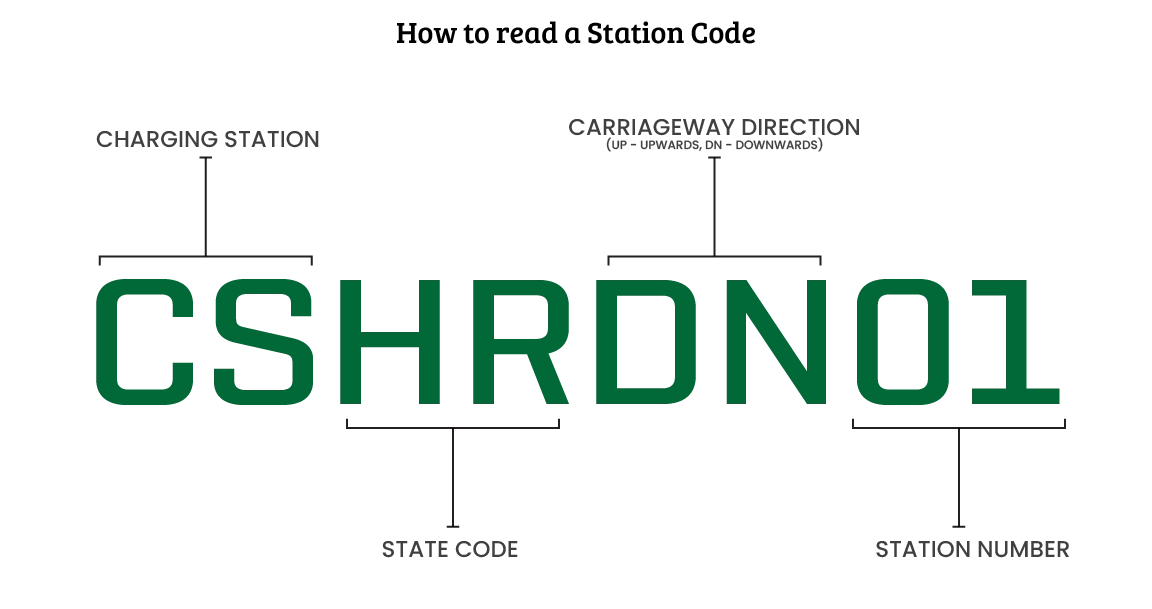
Station Code Legend
Code Prefix
CS — Charging Station
DH — Depot Hub
CR — Control Room
Carriageway Direction
UP — Up direction
DN — Down direction
e.g. CSHRDN01 = Charging Station • Haryana • Down • Station 01
State Code (2-letter segment after the prefix)
- AP — Andhra Pradesh
- BR — Bihar
- DL — Delhi
- GA — Goa
- GJ — Gujarat
- HR — Haryana
- JH — Jharkhand
- KA — Karnataka
- MH — Maharashtra
- OD — Odisha
- RJ — Rajasthan
- TN — Tamil Nadu
- UP — Uttar Pradesh
- WB — West Bengal
Note on “UP”: as the state segment right after the prefix, UP means Uttar Pradesh (e.g. CSRJUP01 is in Rajasthan, using the Up carriageway). As the direction segment just before the station number, UP means the Up carriageway — the two are positional, not the same field.
Before Incorporating This Information Into Any Use
Corroborate and Update
For validation or clarification regarding any station, pricing, allocation or partner information shown here, companies should follow the steps below.
✦ Drop an email to services@nhev.in with your query.
✦ Mention the relevant Station Code, State and UP/DN direction, wherever applicable.
✦Clearly state the specific information that requires validation.
✦ Request confirmation that the PDF / document currently held is the latest and valid version as of the date of enquiry.
✦ Await written confirmation from the authorised NHEV team before relying on the information for any legal, commercial, financial or investment decision.
This process also applies to checking Station information, Pricing / Budget details, Allocation status, Allottee details and LoR Partner details, and for accessing the relevant Allottee and LoR Partner waiting lists — to provide transparency on the current status of prospective allocations and partners.
Disclaimer:
The information contained in these documents is subject to change from time to time. These documents may be used for preliminary budgeting and reference purposes only. Before taking any legal, commercial, financial, or investment decision, the concerned company must cross-check the information against the latest PDF / document applicable as on the relevant date and undertake its own internal verification.
Any decision based on these documents must be duly reviewed and acknowledged in writing by the company’s authorised signatory. In the absence of such verification and authorised acknowledgement, the issuing authority shall bear no liability for any loss, cost, damage, or consequence arising from the use of or reliance upon these documents.
Note: Submission of an enquiry does not constitute approval, allotment, commercial commitment or confirmation unless expressly communicated by the authorised authority.